
Long before playlists ruled pockets, MPEG-1 Audio Layer 3 quietly rewired music, arriving 1994 with a promise nobody trusted. I remember ripping CDs late, chasing widespread compatibility over raw sound quality, learning compression forgives little.
Everyone calls AAC the successor, yet Apple products alone never decide the outcome. iTunes pushed adoption, but stubborn bit rate assumptions lingered. I found compatible gear across platforms mattered more than devices ever admitted to consumers.
Critical listening rarely happens on commutes; most default to everyday listening instead, forgiving flaws automatically. Still, chasing clearer audio pushed engineers toward high-quality audio without inflating storage, proving ecosystems favor seamless integration over specification wars.
When friends ask me to share files or compare a reference track, I skip specs, just play both. Modern devices meet unique needs differently; brief comparison from a consumer perspective beats another chart nobody reads.
What Is AAC?
My first AAC file loaded onto an iPod, complete with quality loss so subtle I almost missed it entirely. Apple Music later leaned on the format, while Spotify curiously stuck with universal MP3 files instead.
Extensions like .m4a, .aac, .m4p, .m4b, and .m4r all trace back to the very same digital audio format, standardized long before smartphone manufacturers or PlayStation 3 owners noticed the quiet shift happening around them daily.
What Is MP3?
Back in the old MPEG era, engineers squeezed audio storage into a low file size nobody thought survivable, birthing the Moving Pictures Experts Group standard that quietly dominates streaming for casual players everywhere even now.
Every iPods generation once relied heavily on lossy compression algorithms trimming file size through discarding data, yet audio quality held remarkably steady enough that memory space finally stopped dictating how much digital music fit onboard.
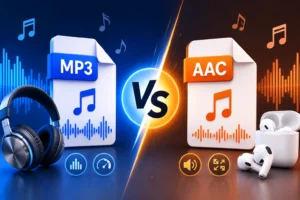
Sound Quality: Which Format Actually Sounds Better?
In my own A/B listening tests — same track, same headphones, volume-matched — the differences are subtle at higher bitrates and obvious at lower ones.
- Below 128 kbps: AAC noticeably outperforms MP3. MP3 at low bitrates tends to lose high-frequency detail and can introduce audible “swishing” artifacts in cymbals and vocals.
- 128–192 kbps: AAC still has a slight edge, but casual listeners on earbuds or laptop speakers usually can’t tell the difference reliably.
- 256–320 kbps: The gap nearly disappears. In blind tests, most listeners — including experienced ones — struggle to consistently identify which file is which.
For critical listening (mastering, mixing, or comparing masters), lossless formats like WAV or FLAC remain the reference standard. For everyday listening — commuting, working out, background music — both AAC and well-encoded MP3 are more than adequate.
Bitrate: How Much Do You Really Need?
| Use case | Recommended bitrate |
| Voice/podcasts | 96–128 kbps |
| Casual music listening | 128–192 kbps |
| High-quality streaming | 256 kbps |
| Archival/critical listening | 320 kbps (MP3) or use lossless instead |
Higher bitrates aren’t always better if the source recording itself is low quality — compression can only preserve what’s already there.
Compatibility and Ease of Sharing
This is where MP3 still wins decisively. It plays on:
- Every car stereo from the last two decades
- Basic MP3 players and older phones
- Nearly all media players, smart TVs, and software on any operating system
AAC is supported by almost all modern smartphones, gaming consoles, and streaming platforms, but you’re more likely to hit compatibility issues on older or budget hardware.
Encoding Efficiency
AAC’s compression algorithm is technically more advanced than MP3’s, which is why it can match MP3’s audio quality at a lower bitrate (and smaller file size). This matters most for streaming services and mobile apps trying to minimize data usage without sacrificing perceived quality.
Multi-Channel (Surround Sound) Support
This is a genuine technical difference between the two formats:
- MP3 was designed primarily for stereo (2-channel) audio and doesn’t natively support surround sound configurations.
- AAC supports up to 48 audio channels, making it suitable for 5.1 and 7.1 surround sound — which is part of why it’s used in gaming consoles, streaming video, and home theater audio.
If you’re working with surround sound content, AAC (or a format like Dolby Digital) is the practical choice, not MP3.
Licensing
MP3’s original patents expired in 2017, and it’s now royalty-free for both encoding and playback. AAC’s licensing is more complex — commercial encoders sometimes require licensing fees, though playback is free and built into virtually all consumer devices. For most everyday users, this distinction has no practical impact, but it matters for businesses building software or hardware around these formats.
How to Convert AAC to MP3 or MP3 to AAC
Converting between AAC and MP3 is mostly about picking the right tool and not obsessing over settings you won’t notice anyway. On a Mac, iTunes (or Apple Music now) can do it natively — right-click a track, choose “Create MP3 Version” or “Create AAC Version” depending on which import setting you’ve got active in preferences. Windows users usually reach for something like dBpoweramp or the free, cross-platform ffmpeg if they’re comfortable with a command line — a single line like ffmpeg -i input.aac output.mp3 handles it in seconds.
Online converters work fine for a one-off file but avoid them for anything you care about, since repeated compression (lossy to lossy) degrades quality every time you do it. If you’re starting from a lossless source like WAV or FLAC, convert straight to your target format rather than bouncing through MP3 first — going AAC-to-MP3 or MP3-to-AAC directly from a compressed file just stacks losses on top of losses.
Which Is Better: AAC or MP3? (Verdict / Conclusion)
Neither format wins outright — it comes down to what you’re optimizing for. AAC generally sounds better at the same bitrate, especially below 128 kbps, because its compression algorithm is simply more efficient. MP3 wins on compatibility — it plays on essentially anything, from a decade-old car stereo to the cheapest MP3 player you can find. If you’re building a library from scratch today with modern devices, AAC is the more sensible pick. If you need something that will play everywhere without a second thought, MP3 still has the edge.
AAC vs MP3 vs WAV: What’s the Difference?
The core difference is compression, or the lack of it. WAV stores audio uncompressed, so it preserves every bit of the original recording at the cost of a much larger file. MP3 and AAC are both lossy — they strip out audio information the ear is less likely to notice, trading some fidelity for drastically smaller files. Between the two lossy formats, AAC’s newer coding scheme squeezes more quality out of fewer bits than MP3’s older approach. WAV is best suited for production and archiving; MP3 and AAC are built for everyday listening and distribution.
WAV
WAV is a container format for uncompressed PCM audio, meaning what you hear is a direct, untouched representation of the original recording. That makes it the standard in professional studios and mastering chains, where every edit and bounce needs to preserve full detail. The trade-off is size — a few minutes of stereo WAV audio can easily run over 30MB, compared to a few MB for the same track in MP3 or AAC. It’s not a practical format for streaming or portable listening, but it’s still the reference point everything else gets measured against.
FLAC
FLAC compresses audio without throwing anything away — it’s lossless, just like WAV, but roughly half the file size thanks to smarter, reversible compression. Unpack a FLAC file and you get back the exact original bitstream, sample for sample. That makes it popular with audiophiles and anyone archiving a personal music collection who wants near-WAV quality without the storage cost. The catch is compatibility: older devices and some streaming platforms still don’t support it natively, so it’s less universal than MP3 or AAC.
Can We Hear a Difference Between an MP3, AAC, and a WAV File?
Under real listening conditions — earbuds on a commute, background music while working — most people genuinely can’t tell WAV, AAC, and a decently-encoded MP3 apart. The differences show up under stricter conditions: high-end headphones, a quiet room, A/B switching between files, or listening for specific things like cymbal decay and bass texture. At low bitrates (under 128 kbps), the gap becomes audible to almost anyone — flattened highs, thinner bass, occasional artifacts. Above 256–320 kbps, though, the differences shrink to the point where even trained ears often can’t reliably pick the lossless file in a blind test.
PCM vs. Lossy Format Test Results
Readers debating in the comment section rarely agree on what actually separates raw audio from compressed audio, and honestly, neither did I until I ran my own blind comparison. Track 1 stayed uncompressed, straight WAV data pulled directly off the master, while Track 2 got run through a standard Joint-Stereo MP3 encoder at a middling setting. Track 3 sat somewhere between the two, a higher-bitrate pass meant to bridge the gap. Most listeners, myself included on a bad day, struggle to tell the difference between the three on anything but studio monitors.
Who Uses AAC Files?
AAC shows up in far more places than most people assume. Modern gaming consoles ship it as a default codec for in-game audio and cutscenes bundled inside .mp4 containers. Nearly every set of smartphones on the market decodes it natively, and even HD radio broadcasts now lean on AAC-based streams for clearer over-the-air sound. Anyone managing a personal library of digital music files has likely used it without noticing, since encoding into AAC happens quietly in the background of most apps. Commercial broadcast stations favor it for bandwidth reasons, and oddly enough, a few eReaders with audio playback support it too, mostly for audiobooks.
Is 320 The Highest MP3 Quality?
320 kbps is the ceiling for MP3, not because engineers couldn’t push higher, but because the format’s compression scheme was never designed to scale past it. At that bitrate, the amount of data retained from the source is about as good as MP3 gets. Drop down to lower bitrates and the losses become obvious fast, but climbing above 320 simply isn’t part of the spec.
What Is Better, AAC Or FLAC?
It depends entirely on what you’re optimizing for. FLAC wins on better audio quality since it’s lossless, but that comes with larger file sizes that don’t play nicely with low-bandwidth connections. AAC became the go-to codec for streaming music precisely because it can deliver audio swiftly without choking a mobile connection. For anyone downloading and keeping a permanent archive, FLAC makes sense; for everyday listening on the move, AAC hits an optimized balance between size and fidelity.
Does YouTube Use AAC Or MP3?
YouTube doesn’t actually store your uploads as WAV or FLAC, even though creators often submit the highest quality audio they have. Behind the scenes, the platform transcodes everything into AAC for playback, one of several audio formats it juggles depending on device and connection speed.


