
YouTube’s Terms of Service and copyright law aren’t the same thing. Learn how they differ and what it actually means for you
By a media rights consultant with over a decade of experience advising creators on copyright disputes, Content ID claims, and platform policy. Last updated: July 2026.
Disclaimer: This article is for general educational purposes only and does not constitute legal advice. Copyright law varies by jurisdiction and case specifics. If you’re facing a strike, claim, or dispute with significant financial or legal stakes, consult a licensed attorney who specializes in intellectual property or entertainment law.
Most creators lump “copyright law” and “YouTube’s rules” into the same bucket. They’re not the same thing, and confusing them is one of the most common — and costly — mistakes I see in this line of work. One is federal law enforced by courts. The other is a private contract you agree to the moment you click “upload.” Understanding where they overlap, and where they diverge, can save you a channel.
What Is Copyright?
A licensing dispute once put me near a court, teaching real leverage. A copyright owner rarely needs a lawsuit — proof a recorded work existed before registration with the US Copyright Office grants exclusive rights automatically.
Forget the narrow assumption that only original works, artwork, or movies qualify — books, photographs, even architectural designs sit under identical protection the instant creation happens, no application needed, no gatekeeper deciding what counts as expression.
Here’s the part creators miss: discoveries, ideas, concepts, and procedures stay unprotected forever, however brilliant. Hum a melody in your head and nothing exists legally; write that song down and intellectual property rights ignite instantly.
What Are The Exclusive Rights?
Copyright isn’t a single protection — it’s a bundle of separate rights that a copyright holder can license, sell, or withhold independently of one another. Under Title 17, Section 106 of the U.S. Code, these include:
- Reproduction – making copies of the work
- Distribution – sharing or selling those copies
- Adaptation (derivative works) – turning a screenplay into a novel, for example
- Public performance – playing music or showing a film publicly
- Public display – showing the work in a public setting
It’s worth noting that simply linking to content that was uploaded legally by its owner doesn’t trigger any of these rights — a distinction that trips up a lot of creators who assume all sharing is equally risky.
How Long Do Exclusive Rights Last?
Clients ask me constantly why a fair use defense feels stronger for a decade-old clip than a brand-new one — the answer sits inside the length of protection, not the content itself, since older works accumulate fewer exceptions worth fighting over.
That protected time period isn’t arbitrary. Congress tied it to the life of the author plus a fixed stretch afterward, because a creator’s heirs deserve income long after the original spark of creation fades from memory.
The number people forget mid-negotiation: 70 years. Miss that window and permission stops mattering entirely — the clock, not the copyright holder, decides when your obligation to ask ends.
What Happens When Copyright Expires?
I once assumed expired protection meant total abandonment, but that’s backwards. The work simply enters the public domain — no owner collecting royalties anymore, no permission gate, just open access for anyone to build on freely, forever.
That shift happens quietly. There’s no ceremony marking protection expiry, no notification email, nothing dramatic — just a quiet legal transition where yesterday’s restricted asset becomes tomorrow’s shared resource, available for remixing, republishing, or reselling without asking anyone first.
Here’s the misconception creators repeat constantly: online availability never signals public domain status. A song streaming everywhere online might still sit fully protected — accessibility and legal status are two completely unrelated questions entirely.
What Can Be “Copyrighted”?
Copyright protects expression, not ideas, facts, or data. That means the following are never protected:
- Government works (in most cases)
- Scientific principles, theorems, and natural laws
- Laws, regulations, and court opinions
- Individual words, names, numbers, and short phrases
These stay part of the public domain permanently, forming the building blocks that all creative work is built from.
What Is A Copyright Strike?
A creator once messaged me and panicked over a video takedown, convinced the whole channel was doomed instantly. A copyright holder flagging one clip’s audio or images without proper license doesn’t threaten broader rights immediately though.
Money disappears quietly too, ad revenue dries up, monetization eligibility gets suspended, and live stream privileges vanish overnight. That’s the real channel-wide effect nobody warns new creators about before their first violation lands quite hard.
What Happens When You Receive A Copyright Strike?
A friend once sat frozen for seven days, refusing to touch her channel after a single copyright strike trigger hit her account, certain everything was collapsing. That panic is common, but the reality moves slower and more procedurally than most people expect.
The moment a claim escalates, a viewing restriction locks the video from public reach while the platform processes the underlying formal dispute. Nothing about this is instant — creators sometimes assume a delayed takedown means the claim vanished, when really it’s just working through queue backlogs.
If the original footage relied on a music license that lapsed, or if you never secured one at all, the fastest resolution is to mute audio or replace copyrighted material outright rather than wait on an appeal. Doing so can trigger monetization restoration and reopen ad revenue collection almost immediately.
What Is A Copyright Claim?
A Content ID claim rarely spells doom — it’s simply an automated management tool confirming someone holds ownership and digital rights over sound or footage buried inside your uploaded content. Constant scanning flags matches, and a notification lands quietly in your dashboard.
Consequences vary by individual video: some face a revenue claim redirecting ad placement dollars elsewhere, others hit a regional restriction blocking viewers entirely. Occasionally it’s a false claim, and submitting proof of ownership or a valid license brings no action against your flagged video.
How Content ID Works
Behind every claim sits a detection system built on sophisticated technology, scanning audio and video streams against a database of owned media protected under US Copyright Law. When a match surfaces, a notification reaches the uploader automatically.
Rights holders keep full control over next steps — some accept ad revenue share, others file a manual claim disputing publication rights, and a few escalate straight to a takedown notice or video removal request, though Fair Use Law can still shield legitimate use.
Copyright Claim and Copyright Strike: Here’s the Difference
This is where most confusion happens, so it’s worth being direct about it.
A copyright claim is largely automated and invisible to your audience. Your video stays up, your channel keeps running, and the only real consequence is usually financial — ad revenue may be redirected to the rights holder, or the video may be restricted in certain regions. Claims are common, reversible, and rarely threaten your channel’s standing.
A copyright strike is a formal legal accusation filed by a rights holder who believes their content was used without authorization. This is far more serious: it results in the video being removed, a strike against your account, and — if you accumulate three strikes within 90 days — termination of your entire channel, along with any associated channels.
| Copyright Claim | Copyright Strike | |
| Trigger | Automated Content ID match | Formal complaint by rights holder |
| Video status | Usually stays live | Removed immediately |
| Channel risk | Minimal | Can lead to termination |
| Typical resolution | Automated or by proof of license | Counter-notice, retraction, or 90-day expiry |
Avoiding Copyright Claims And Copyright Strikes
Most creators wait until disaster strikes before thinking about prevention, but the smarter move happens upfront. Reaching out for direct contact with a copyright holder before uploading anything borrowed beats scrambling for damage control afterward every single time.
Explicit permission doesn’t require a lawyer or a lengthy negotiation — often it’s a quick email exchange, though creators paralyzed by infringement fear skip this step entirely and gamble instead, hoping nobody notices.
Building your library around royalty-free content sidesteps most headaches from the start. Platforms offering creative commons licensing typically spell out permissive terms clearly, so you know exactly what’s allowed without guessing or hoping a fair use exception will save you later.
YouTube’s Fair Use Policy
Fair use is not a blanket shield — it’s a legal exception under Title 17, Section 107 of U.S. Copyright Law that permits limited use of copyrighted material for purposes such as commentary, criticism, education, parody, and news reporting.
There’s no universal rule about how many seconds of a clip you’re “allowed” to use. Courts evaluate fair use on a case-by-case basis using four factors:
- Purpose and character of the use — Is it transformative, or just repackaged commercial content?
- Nature of the original work — Factual works get more leeway than creative ones.
- Amount and substantiality used — Even a short clip can fail this test if it captures the “heart” of the work.
- Effect on the market — Does your use compete with or reduce demand for the original?
A reaction video, commentary piece, or parody may qualify, but simply adding narration over someone else’s footage does not automatically make it fair use. Context and intent matter, and fair use is ultimately decided case-by-case — sometimes only after a legal dispute.
Also worth knowing: fair use is a U.S. legal doctrine. Many other countries have narrower “fair dealing” exceptions, so content that’s defensible in the U.S. may not be protected elsewhere.
What Is Fair Use? (Legal Definition)
Most people think fair use is some vague courtesy YouTube extends to creators, but it’s actually codified law — Title 17, Section 107, to be exact — carving out permission exemption for specific purposes like teaching, research, scholarship, reporting, criticism, and parody.
Here’s what surprises clients constantly: there’s no bright-line rule dictating exactly how many seconds of a clip you can borrow safely. Judges weigh decision-making factors against case specifics, meaning limited copying that survives scrutiny in one dispute might sink an entirely different creator using nearly identical footage.
The Four Fair Use Factors
Courts don’t just eyeball a video and guess — they run through four distinct lenses, starting with purpose and character, asking whether your use qualifies as transformative use or leans toward straightforward commercial use dressed up as nonprofit educational use.
Next comes the nature of the work itself. Borrowing from factual works carries more latitude than lifting from creative works, and pulling from unpublished works invites far harsher treatment than quoting something already circulating as published works.
Then there’s the amount used — not just raw minutes, but significance of portion, since grabbing the emotional heart of the work can doom you even at thirty seconds. Finally, judges examine market effects: does your upload threaten the potential market, create market substitution, or damage licensing impact for the original owner?
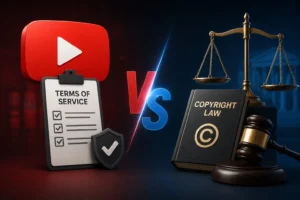
Terms Of Service Vs. Copyright Law
A lot of creators assume YouTube’s rulebook and actual contract law are the same beast, but that’s a mistake I made early in my career too. Website terms of use operate more like a click-through agreement — you accept them, often without reading, the moment you hit upload.
Copyright law answers to courts and statutes; platform policy answers to whoever wrote the fine print. That distinction matters most when a contractual breach claim surfaces — YouTube can enforce its own generic website terms regardless of whether actual infringement occurred, since enforceability here rests on user consent, not judicial precedent.
Here’s the layer people skip entirely: visibility of terms matters legally. Clicking a consent button buried in a signup flow counts as constructive notice even without actual notice that you read anything — courts have upheld this repeatedly across both state law and federal law jurisdictions.
Institutions like archives, museums, and university special collections navigate this constantly through database agreements and library agreement frameworks, where a library-subscribed database might impose stricter conditions than copyright itself would ever require. That’s the trap — contracts can supersede rights you’d otherwise hold, creating a fair use override that has nothing to do with fair use law and everything to do with what you signed.
Anyone doing publishing work off publicly-available content should run a genuine risk calculation before assuming access equals permission. Access barriers aren’t always technical — sometimes they’re contractual, and ignoring them invites real damages, entirely separate from any copyright dispute a court might otherwise resolve.
Frequently Asked Questions
What Is A YouTube Copyright Strike and How Does It Work?
A strike begins as a legal complaint — a formal accusation filed by a copyright owner who believes unauthorized use occurred on your channel. It typically results in video removal, a channel strike against your account, and a serious warning about future violations.
What Happens If I Receive Multiple YouTube Copyright Strikes?
Racking up three strikes within 90 days triggers account termination outright. YouTube doesn’t stop there either — associated channels face the same fate, videos removed across the board, plus a new channel prohibition preventing you from simply starting over under a fresh name.
What’s The Difference Between A Copyright Strike And A Content ID Claim?
A claim rarely escalates to formal legal action; it’s largely an automated process focused on monetising or blocking the content quietly. A strike is different entirely — it carries real consequences, whereas a claim typically means no strike issued against your account at all, and channel termination stays off the table unless things worsen dramatically.
Can I Appeal Or Resolve A Copyright Strike?
Yes — filing a counter-notice works when you believe it’s an error claim, especially if you have solid fair use grounds. If the claimant doesn’t respond, a complainant retraction or the standard 90 days expiry window typically resolves things in your favor automatically.
Does It Work In The Public Domain If I Find It Online?
Not necessarily. Online publication doesn’t automatically mean public domain status — plenty of publicly accessible content remains fully protected. Verifying copyright compliance before reuse matters more than assuming availability equals permission, a mistake that costs creators dearly.
Can A Copyright Claim Turn Into A Strike?
Generally no, but exceptions exist. A Copyright ID claim stays separate from formal action unless the rights holder files a valid claim escalation like a video takedown request. Continued neglect of the issue can eventually invite a genuine copyright strike, though proactive removal of flagged material usually prevents that outcome.
What Copyright Is Protected On YouTube?
Protection covers creative works the moment they exist in fixed form — automatic protection requires no registration. A music recording or video file qualifies instantly upon reaching tangible form, provided it demonstrates genuine originality rather than copying something that already exists.
Rules For Using Copyrighted Material On YouTube
Always secure owner permission before reusing someone’s work, unless you’re confident a fair use exception or fair dealing exception genuinely applies. Staying within guidelines compliance matters — leaning on royalty-free content, proper licensing, and consistent infringement avoidance keeps your channel safe long-term.
Small Claims — The CASE Act & Copyright Claims Board
Most creators can’t afford federal court litigation over a modest infringement, which is exactly why Congress passed the CASE Act back in 2020, establishing the Copyright Claims Board as a genuine alternative.
The CCB, housed within the U.S. Copyright Office, offers a small-claims tribunal designed for smaller disputes, capping potential awards through a damages cap of $30,000 — far less than what a full lawsuit might yield, but dramatically cheaper and faster to pursue.
Importantly, every notice recipient retains the right to opt out entirely, redirecting the dispute back toward traditional federal litigation if they’d rather not participate in this streamlined process.
AI & Copyright
Every AI lawsuit boils down to the same core tension: does feeding copyrighted material into training data trigger the exclusive rights bundle — reproduction, distribution, display, and performance — or does AI training fall outside that framework entirely?
Cases like Bartz v. Anthropic and Kadrey v. Meta wrestle with exactly this, often drawing comparisons to older precedent like HathiTrust and Google Books, where courts found scanning for search purposes qualified as non-commercial research rather than infringement.
The messier fight centers on derivative works — does an education exception cover model training the same way it covers a classroom photocopy? Courts increasingly focus on substantial similarity and output similarity, since the real infringement question isn’t whether training occurred, but whether generated output too closely echoes protected originals.
How to Avoid Copyright Claims and Strikes
- Ask first. A short email requesting permission is often all it takes, and it beats a takedown notice every time.
- Use royalty-free or Creative Commons content. These sources clearly state what’s permitted, removing the guesswork.
- Don’t assume fair use will save you. Build your case for transformative use before you publish, not after you’re flagged.
- License your music properly, and keep records of the license in case a claim is issued in error.
- Edit quickly if flagged. Muting audio or removing the disputed clip is often faster than waiting on a dispute resolution.
Library Permissions
Universities sit in a strange spot legally — a special collections department might hold materials that read as public domain on the surface, yet still carry a license requirement attached through whatever agreement brought them into the archive originally.
I’ve watched researchers assume walking into somewhere like the Bancroft Library grants automatic reuse rights, only to discover a general collection item requires a formal permission request before publication, regardless of how old the underlying work actually is.
Fair use doesn’t disappear inside library walls, but it also doesn’t override institutional policy layered on top of copyright itself — two separate gatekeepers, both demanding satisfaction before you walk away with usable material.
Sources and Further Reading
- U.S. Copyright Office – Copyright Basics
- 17 U.S. Code § 106 – Exclusive Rights
- 17 U.S. Code § 107 – Fair Use
- YouTube Help – How Content ID Works
- U.S. Copyright Claims Board


