
My friend once bragged his setup sounded cleaner after one switch in encoding, yet most people staring at a confusing menu on their computer never quietly ask what that dropdown menu truly controls before export.
I once spent a whole week ripping 500 CDs, treating the ripping process as basic sonic information, feeding every CD into storage as source audio — some tracks became garbage quality, others held despite inferior quality.
As a developer, I treat bitrate as neither ceiling nor floor, plain language for file size, sound quality — 320 kbps, 128 kbps, MP3 kbps mean less than ears, bandwidth, streaming platforms, real-world differences, random play.
Every guide promises balance, yet each situation differs: audio files on SoundCloud after exporting demand streaming clarity, data usage shrinks while fuller sound survives listening, uploading ignores detail in recording — overkill audio beats sacrificing quality.
What Is Audio Bitrate / What Kbps Means
Picture a photo losing resolution each time it’s squeezed smaller — an MP3 encoder does something similar to sound, working from a fixed budget every second and deciding what detail gets to stay. The label kbps (kilobits per second) — 128, 192, 256, or 320 — is just that budget written as a number, though a typical listener rarely stops to ask why.
Lossy format compression always means giving something up. Rather than pick randomly, the encoder hunts for nuances a typical listener won’t miss, then it will throw away whatever’s left — meaning sound information and sonic information both take a hit before you ever press play. Cymbals in orchestral music, or layered vocals stacked against lead vocals, are usually the first casualties; instruments crowd together, and clarity thins out fast.
There’s a strange compromise buried in all this: lower bitrate keeps files small but forces the encoder to discard more than it should, while higher bitrate protects fuller listening experience at the cost of storage. Common rungs like 128, 192, and 256 exist because nobody agrees where that trade feels comfortable, and data never asks for our opinion. Even subtle details — the ones you’d swear don’t matter — quietly decide whether a track feels alive or flat.
Why Audio Bitrate Matters
I used to treat bitrate choices as an afterthought until storage space ran out mid-project. Really it comes down to three key things: how a track survives streaming, how it behaves the moment you upload it somewhere, and whether sound clarity holds up on cheap earbuds or a proper system.
Data usage matters just as much on mobile data as at home — a lower bitrate file barely dents your plan, while higher bitrate protects high-quality audio for critical listening. The honest clean result you’re chasing depends on picking the right one for where the track is actually headed.
How Audio Bitrate Works
Strip away the marketing and audio bitrate is just compression deciding what sound information survives. At 128kbps, more gets cut before it reaches your headphones; at 320kbps, fewer details removed means the track keeps more of its shape through speakers too.
Streaming platforms rarely advertise this, but the gap becomes a noticeable difference only when smooth playback isn’t the only thing you’re listening for.
Can You Hear The Difference? (Listening Comparison)
Ask any average music listener what separates 128 kbps from 320 kbps, and most will admit the gap only reveals itself under specific conditions — never as a fixed, universal rule.
Take a house party or a crowded wedding dance floor: run a blind test there and the whole exercise becomes much ado about nothing, since cheap earbuds, phone speakers, and general noise flatten everything into near-identical casual playback. A noisy room hides more flaws than any encoder ever could.
Move to a quiet room with good headphones or studio headphones, though, and the story flips. Crispness on cymbals, the reverb tail trailing off a snare, the fine detail buried in a busy mix — these surface first, and trained ears pick them out fastest. Instrument separation in dense music, especially orchestral or electronic work with layered tracks, stresses an encoder harder than a single voice ever will; acoustic guitars and lead vocals hold up fine even on basic earbuds, but stack a full arrangement and things get cramped.
Low-quality streaming at the minimum acceptable standard tends to sound swishy, fuzzy, or plain muddy — that’s the high-end getting cut first, since high frequencies and low frequencies absorb most of the damage before midrange vocals do. A jump to 192 kbps already reads as a solid step up in transparent quality, where most music lovers stop noticing artifacts at all.
Context still decides everything. Laptop speakers in a car, or Bluetooth speakers at a barbecue, mask far more than mid-range headphones ever would — try shuffling tracks in random order across a personal music library and you’ll find casual listening rarely exposes the seams. Only on a high-fidelity audio system does the leap toward FLAC, ALAC, or true lossless audio start separating itself from a well-encoded 320 kbps file, and even then, it’s subtle rather than dramatic.
Rank the tiers honestly — small, basic, low bitrates at the bottom; larger, high, higher ones climbing toward quality headphones territory — and you’ll notice sound quality stops improving noticeably long before the file size does. Compare clip 1 and clip 2 yourself: to the naked ear, digitally encoded audio at a strong bitrate often fools even confident listeners in everyday listening, and critical listening is really the only condition where the difference stops hiding.
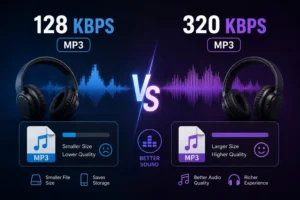
File Size: The Real Trade-Off
Storage math is simple and doesn’t lie: kilobits per second scale directly into megabytes on your device. Here’s roughly what to expect for a typical song:
| Bitrate | ~3-Minute Track | ~4-Minute Track |
| 128 kbps | ~2.8 MB | ~3.5 MB |
| 192 kbps | ~4.2 MB | ~5.5 MB |
| 320 kbps | ~7 MB | ~9–10 MB |
Multiply that across an album, a podcast library, or a full archive, and the gap stops feeling trivial. Modern devices rarely struggle with storage the way they did a decade ago, but a capped data plan still makes smaller files worth choosing deliberately rather than by accident.
It’s worth repeating: bigger files buy headroom for detail, not automatic quality. A poorly recorded track encoded at 320 kbps is still a poorly recorded track — just a larger one.
Which Bitrate Should You Pick / Recommended Bitrates by Use Case
There’s no single “best” setting — the right choice depends on what you’re encoding and where it’s going.
- Spoken word (podcasts, interviews, audiobooks): 64–128 kbps mono is usually plenty. Human speech occupies a narrow frequency range, so it compresses cleanly without sounding thin.
- Everyday music listening: 192 kbps or a comparable VBR setting covers most listeners without wasting storage or bandwidth.
- Archiving, CD rips, or paid digital purchases: 320 kbps or a lossless format like FLAC/ALAC protects fidelity for the long term.
- Mobile devices with limited storage: Around 160 kbps is a reasonable middle ground between space and sound quality.
- Professional mastering or distribution: Skip compression formats altogether and use WAV or AIFF, since no lossy export can recover detail that gets discarded during compression.
If you’re uploading to a platform like SoundCloud or a podcast host, encoding at a higher bitrate up front gives you a buffer against quality loss from any re-compression the platform applies later.
Audio Bitrate Comparison: 128kbps vs 320kbps vs Lossless
Line up every tier side by side and the picture gets clearer than any single comparison ever manages alone. 128kbps sits at the basic end — a small file size, modest sound quality, still an MP3 at heart. 320kbps climbs to high, sometimes framed as very high for a lossy format, landing in medium territory once you weigh compression against what actually survives.
Step past both and you hit CD quality audio — 1411kbps, fully uncompressed, no bitrate budget squeezing anything away. That number alone runs four times higher than 320kbps, which says plenty about how much headroom lossy formats give up just to stay portable.
FLAC, running somewhere between 700kbps and 1100kbps, closes most of that gap — it’s lossless, so nothing gets discarded, yet the audio type stays efficient enough to store comfortably, unlike raw CD data. I’ve swapped between all four myself on the same track, and the honest takeaway is that large files don’t automatically mean better listening — they just mean less was thrown away before it reached your ears.
Bitrate Comparison at a Glance
| Format/Bitrate | Approx. Data Rate | Category |
|---|---|---|
| MP3 128 kbps | 128 kbps | Basic, small file size |
| MP3 320 kbps | 320 kbps | High quality for a lossy format |
| FLAC | ~700–1,100 kbps | Lossless, efficient |
| CD Audio (uncompressed) | 1,411 kbps | Full lossless, no compression |
CD-quality audio runs roughly four times the data rate of a 320 kbps MP3, which shows how much headroom lossy formats sacrifice in exchange for portability. FLAC closes most of that gap: it’s lossless, so nothing is discarded, but it stores far more efficiently than raw, uncompressed CD data.
The Trade-Offs of Higher Bitrate
Advantages:
- Sharper clarity, especially in cymbals, strings, and layered vocals
- Better instrument separation in dense mixes
- A more natural, less compressed-sounding listening experience, especially on headphones
Disadvantages:
- Larger files consume more storage
- Streaming higher bitrate files uses more mobile data, which can mean more buffering on slower connections
How Human Hearing Affects Bitrate Quality
Human hearing operates within a fixed window — roughly 20Hz at the low end up to 20,000Hz at the top — and that window is exactly what audio compression exploits. Encoders lean on psychoacoustic compression, a method built around what the ear genuinely notices versus what it quietly ignores during sound removal.
Subtle details sit right at that boundary. At 128kbps, more of them vanish before playback even starts; at 320kbps, enough survive that trained listeners often report a richer sound, not because more data exists, but because less of what mattered got discarded along the way.
How Streaming Platforms Handle Bitrate
Most streaming platforms don’t commit to one number permanently — they lean on adaptive bitrate streaming, quietly running an audio quality adjustment in the background depending on conditions. A slow connection triggers a drop to protect smooth streaming, while a strong connection unlocks higher audio bitrate playback without you noticing the switch.
This matters most on mobile data, where internet speed fluctuates constantly. I’ve watched buffering kick in mid-track purely because the network dipped, not because the file itself changed — the platform simply adjusted on the fly to keep things moving.
Frequently Asked Questions
Is 320 kbps always better than 128 kbps?
Not in raw terms across every situation. On headphones built for complex music, the audible difference is real, but through cheap phone speakers or basic earbuds in everyday situations, detail preservation rarely matters enough to notice.
What does kbps mean on an MP3?
Kbps measures bitrate — how many kilobits get spent per second of sound. The MP3 encoder uses that budget to decide what stays and what it must discard from the original audio, directly shaping final quality and larger file sizes.
How much bigger is a 320 kbps file than a 128 kbps one?
Roughly two and a half times larger. A four-minute track near 3.5 MB at low bitrate climbs past 9 MB to 10 MB at the top tier — that gap in file size scales predictably with 4 MB as a rough midpoint reference.
Will exporting at 320 kbps improve low-quality audio?
No. A higher export setting can’t restore detail the original recording never captured. If the source carries flaws, choosing 320 kbps just stores those same issues in a bigger file — bitrate sets a ceiling, never a floor.
What’s the difference between CBR and VBR?
CBR spends a fixed data rate across every second regardless of content. Variable bitrate — VBR — adjusts dynamically, using more through complex passages and less through simple passages, often beating an average file at 320 kbps while staying a genuinely safe choice and reasonably predictable.
Which bitrate is best for podcasts or speech?
128 kbps handles spoken-word audio comfortably, since human voices compress cleanly without losing intelligibility. Clean compression keeps the smaller file practical; save 320 kbps for actual music, where good speakers reveal extra detail that speech never needed anyway.
Is a higher audio bitrate safe for devices?
Yes. Higher audio bitrate files run fine on phones, tablets, and computers without risk — they’re entirely safe. The only real cost is extra storage consumed and more internet data used whenever you stream or transfer them.
Is choosing between 128kbps and 320kbps legal?
Completely. Selecting audio bitrate is just a quality level choice, nothing more — there’s no legal issue involved whatsoever. 128kbps and 320kbps are simply export settings, and rules around copyright apply to content, not compression numbers.
Does 320kbps work on mobile phones?
Yes, without complications. 320kbps plays fine across smartphones and other modern phones — no issues there — though it does raise mobile data usage noticeably compared to lighter files when you’re streaming rather than storing locally.
Why does audio still sound bad at 320kbps?
Usually the bitrate limitation isn’t the culprit. If the original recording already suffered from low quality — bad mic, heavy noise, poor mixing — then missing details were baked in long before 320kbps ever got involved.
What are alternatives to MP3 bitrate formats?
Beyond standard MP3, AAC offers similar efficiency at comparable sizes, while FLAC provides full quality without loss, useful alternatives when a larger file size is acceptable in exchange for preserving everything the original captured.
Is 128kbps good enough for casual listening?
For genuinely casual listening — background music, simple earphones, nothing critical — 128kbps holds up fine. Most people find it delivers acceptable quality for everyday listening without ever noticing what got trimmed away.
Does a higher bitrate drain the battery faster?
Practically speaking, no. Higher bitrate files cause only minimal difference in battery drain; internet streaming itself, especially over weak signal, taxes power far more than the actual bitrate impact of decoding a bigger file.



Pingback: How to Convert YouTube Shorts Audio to MP3 (Step-by-Step)